

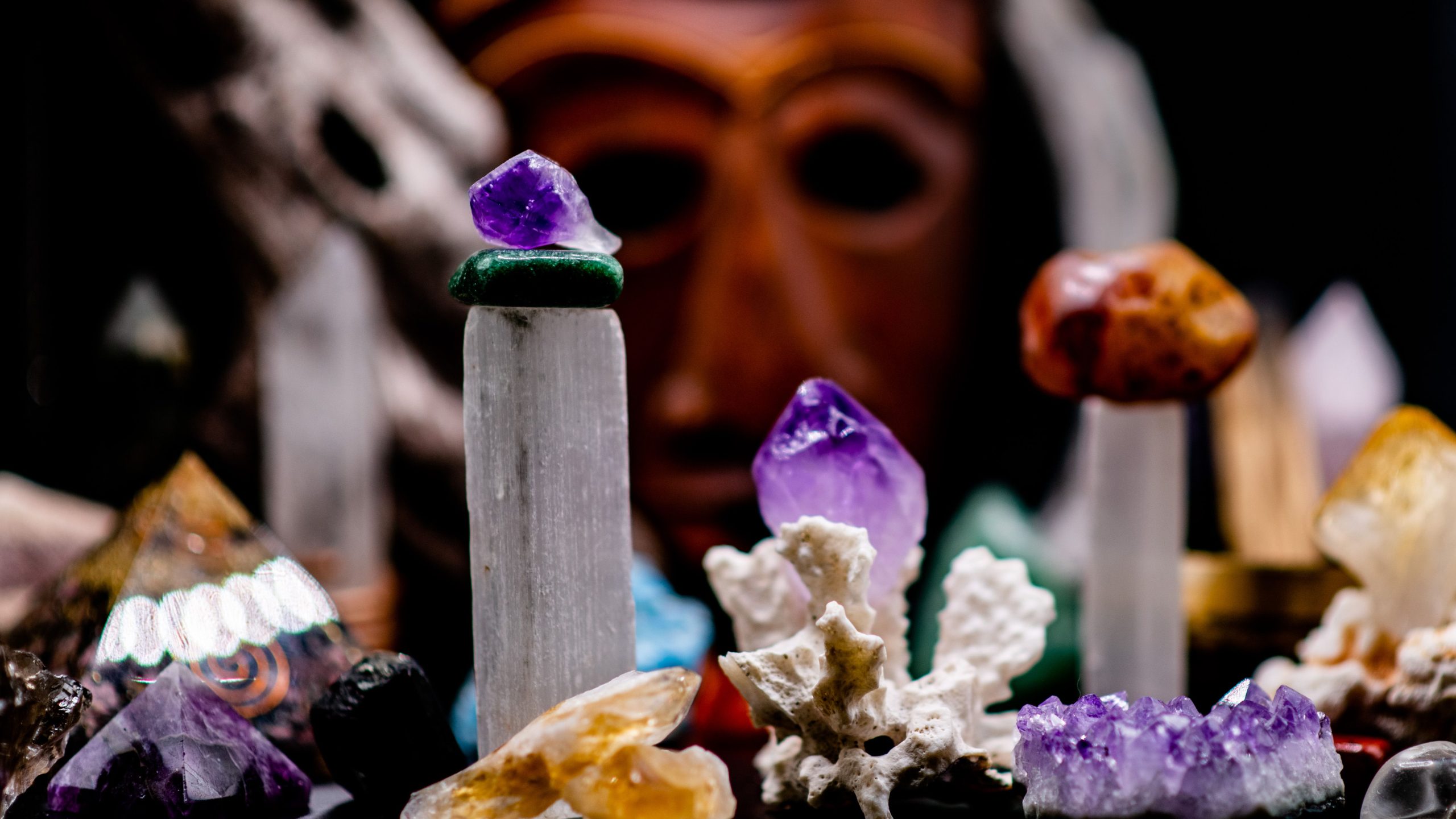
Crystals · Symbolism and reflection
21 stones for an intentional reflection practice
A crystal can be a beautiful object, a keepsake or a personal reminder to pause. If you enjoy using stones while journaling or reflecting, this guide offers a practical way to explore the idea without treating crystal lore as a promise of psychic ability.
Explore 21 stones through optional symbolic themes and a question for each—not a scientific ranking. No purchase is necessary, and the questions work just as well without a stone.
What are you trying to develop?
If by intuition you mean noticing a feeling or an impression before you can explain it, begin by becoming more specific about that experience. What did you notice? What did you infer? What could you check? Feeling certain is not the same as being right.
A stone can serve as a chosen cue for this process, like a bookmark reminding you where to begin. It should not become the authority that decides what is true. Avoid letting an “energy” explanation replace direct communication, reliable information or appropriate professional advice.
Choose a theme that fits your question: communication, boundaries, reflection or a manageable next step. You do not need a different crystal for every concern. The themes below are suggested reflection tools, not universal rules or verified properties of the materials.
The 21-stone reflection guide
1. Lapis lazuli
Optional theme: Truth and expression. Instead of expecting a stone to reveal a higher truth, use it as a reminder to distinguish what you know from what you hope is true. Third-eye language can be meaningful within a spiritual practice, but it does not verify information about another person.
Reflection prompt: What am I reluctant to say, and how could I express it accurately and kindly?
2. Labradorite
Optional theme: Curiosity about uncertainty. Let this stone represent curiosity about hidden assumptions and uncertainty. You do not need to buy it first, or at all, to explore intuition. A feeling of mystery is not evidence of a psychic message.
Reflection prompt: What is one explanation I have not considered, and what could I check?
3. Blue lace agate
Optional theme: Careful communication. Use this stone as a symbolic cue to slow a conversation down rather than assume you understand someone’s feelings. Communication develops through asking, listening and checking understanding. Owning a crystal does not qualify you as a healer or make an impression about a client accurate.
Reflection prompt: Can I repeat what I heard and ask whether I understood correctly?
4. Amethyst
Optional theme: A pause before responding. If amethyst has spiritual meaning for you, it can mark a quiet moment before journaling. Descriptions of opening the crown or third-eye chakra belong to a spiritual framework; they are not measurements of improved perception. A calm moment can still contain an incorrect interpretation.
Reflection prompt: What do I notice when I pause, and what information is still missing?
5. Celestite
Optional theme: Dream reflection. Use this stone as a cue for dream journaling without assuming that a dream came from an unseen source. Write down the dream before searching for connections, and distinguish its imagery from any claim about waking events.
Reflection prompt: What emotion stood out in the dream, and what does it remind me of?
6. Fluorite
Optional theme: Organizing your thoughts. Rather than expecting a stone to remove mental clutter, put it beside a page divided into facts, questions and next steps. The organizing activity is something you can actually evaluate. An answer that feels clearer is not necessarily correct, so leave space for revision.
Reflection prompt: Which question needs attention now, and which can wait?
7. Black obsidian
Optional theme: Boundaries and honest reflection. Use the protection theme as a metaphor for an ordinary boundary: declining an invitation, limiting a difficult conversation or asking for privacy. Do not rely on a stone as a shield against danger or as evidence of hostile energies. Looking inward should not become a demand to uncover frightening hidden truths.
Reflection prompt: What limit could I communicate directly instead of hoping someone will sense it?
8. Moonstone
Optional theme: Making room for feelings. Feelings deserve attention without having to become instructions. You might use moonstone as a reminder to name an emotion before acting. That is different from promising emotional healing, control or an infallible gut feeling. You can choose a gentle next step while remaining unsure about the larger decision.
Reflection prompt: What am I feeling, and what response would respect both my needs and the facts?
9. Clear quartz
Optional theme: A specific intention. Let this stone stand for a clear, manageable intention rather than a battery that amplifies psychic energy. An intention such as asking one honest question gives you something observable to do. A promise to receive a perfectly clear answer leaves no reliable way to separate imagination from knowledge.
Reflection prompt: What action would show that I followed through on today’s intention?
10. Sodalite
Optional theme: Self-inquiry without self-judgment. The useful theme here is reflection and honest expression, not a promise to remove anxiety. Write down a belief and consider where it came from. You can notice doubt without treating doubt as a spiritual failure. Persistent distress needs suitable support, not a stronger stone or more forceful belief.
Reflection prompt: What would I say about this situation if I felt free to admit uncertainty?
11. Citrine
Optional theme: Confidence with a reality check. Use the personal-power theme to name a choice you can actually make. Claims about raising frequency, opening a chakra or attracting outcomes are spiritual interpretations, not guarantees of accurate information or success. Confidence is most useful when it includes permission to change course.
Reflection prompt: What is within my control, and what outcome cannot I promise?
12. Serpentine
Optional theme: One manageable next step. This stone can represent steadiness in your personal practice. Instead of asking it to reveal your path, list two or three available options and the information needed for each. Acceptance does not mean approving everything that happens or remaining in a situation that is harmful.
Reflection prompt: What small, reversible step could help me learn more?
13. Blue apatite
Optional theme: Patterns in your present life. Keep the curiosity theme while treating past-life imagery as imaginative or spiritual material, not a recovered factual history. To explore a recurring difficulty, begin with examples you can identify in your current life. Do not turn a suggested story into an accusation about someone else.
Reflection prompt: When has this pattern occurred, and when has it not occurred?
14. Kyanite
Optional theme: Checking rather than mind-reading. Let the communication theme lead to an actual conversation. Neither a crystal nor a feeling of connection establishes telepathy, divine instructions or another person’s consent. You may find a spiritual practice personally meaningful while still asking direct questions and accepting answers that surprise you.
Reflection prompt: What have I assumed someone wants, and how can I ask them?
15. Ametrine
Optional theme: Holding two considerations together. GIA describes ametrine as quartz displaying the colors of amethyst and citrine in the same crystal. That physical description does not establish an ability to improve decisions. As a metaphor, its two-color theme can remind you that both emotion and practical information deserve space.
Reflection prompt: What matters to me emotionally, and what practical condition also needs to be met?
16. Malachite
Optional theme: Change at a tolerable pace. You do not need to regard distress as evidence that a stone is clearing emotional blockages. If the change theme appeals to you, choose something specific and modest to reflect on. Stop a practice that feels overwhelming; there is no requirement to push through discomfort to prove spiritual readiness.
Reflection prompt: What would a kind, realistic change look like this week?
17. Blue calcite
Optional theme: Turning reflection into action. Instead of assuming it magnifies psychic strengths or makes the law of attraction work, use this stone as a reminder to translate a thought into a practical plan. Positive expectations do not remove uncertainty, financial limits or other people’s choices. A useful plan includes a way to review what happened.
Reflection prompt: What action, deadline and check-in would make this idea concrete?
18. Moss agate
Optional theme: Attention to your surroundings. The nature theme offers a straightforward exercise: observe a plant, the light through a window or changes in your yard. Describe what you can see before giving it a meaning. You can enjoy the sense of connection without claiming to detect invisible energies or diagnose another person’s mood.
Reflection prompt: What three details did I overlook before I slowed down?
19. Rose quartz
Optional theme: Compassion with consent. A symbolic reminder of kindness can be useful without a promise of healing. Listening includes making room for a person to disagree, decline help or want privacy. You do not have to know what is in their heart to offer respectful company, and you do not need to fix every difficult feeling.
Reflection prompt: Would this person prefer listening, practical help or space?
20. Selenite
Optional theme: Beginning and ending a practice. If you like a reset ritual, place a stone beside your notebook to mark the start, then close the notebook when you finish. Claims about purifying auras or cleansing another crystal’s energy are spiritual beliefs, not established physical effects. A symbolic ritual does not replace ordinary cleaning or care.
Reflection prompt: What would help me leave this reflection session and return to my day?
21. White topaz
Optional theme: Clarity about values. Treat the truth-compass theme as an invitation to state your values, not as a method of verifying a claim. Something can feel aligned with your hopes and still be impractical or mistaken. Compare your impression with the available evidence before making an important commitment.
Reflection prompt: Which value is guiding me, and what evidence might change my mind?
A simple practice you can evaluate
- Choose one ordinary question. For example, how to approach a conversation or organize a weekend project. Avoid treating a crystal exercise as a decision-maker for health, legal or financial matters.
- Write down your first impression. Keep it separate from facts and from the result you want.
- Use one prompt above. Set the stone on a stable surface if you have one. You do not need to feel anything unusual.
- Choose a small action. Ask a question, check a detail or compare options.
- Review the outcome. Record what you got wrong as well as what helped. Do not change the original impression afterward to make it fit.
Illustrative example: At your kitchen table, you use the moss-agate prompt while planning containers for your yard. You initially feel that one corner would suit a plant, then check how much light the spot actually receives and the plant’s care instructions. The stone represents a pause to observe; the decision rests on information you can check.
Choosing and caring for a stone
If you already own something you enjoy, start there. If you decide to buy, set a modest limit, ask what material is being sold and whether it has treatments, and read the seller’s return terms. A claim that an expensive or rare stone will unlock powers is not a reason to exceed your budget.
Care depends on the material and any treatment. GIA’s jewelry-care guidance explains that light, heat, chemicals and cleaning methods can affect gemstones. Do not assume every item can be soaked, left in sunlight or put in an ultrasonic cleaner. Ask for material-specific care instructions, especially for fragile specimens or jewelry.
Keep this practice external: do not swallow stones, grind them, add unknown minerals to drinking water or use them in place of prescribed care. Keep small pieces away from children and pets. A symbolic “cleansing” practice is not a safety test or a substitute for identifying the material.
What should progress look like?
Look for clearer questions, more honest notes and better follow-through—not a requirement to hear messages or see visions. You can find a practice meaningful even if it does not establish anything supernatural. You can also stop if it becomes expensive, stressful or difficult to step away from.
For another grounded reflection approach, read our higher-self reflection guide. Keep your judgment, respect other people’s boundaries, and let curiosity coexist with the freedom to say, “I don’t know.”
This article is a breath of fresh air! 🌟 I’ve always believed in the power of intuition, and the mention of crystals adds an exciting layer. I can’t wait to explore these stones and see how they enhance my spiritual journey!
Honestly, this seems like a bunch of mystical nonsense. 🤔 Crystals for intuition? I can’t believe people actually buy into this. Intuition is just gut feeling, not some magical energy from rocks.
This post does an excellent job explaining intuition and its connection to spirituality. It’s fascinating how our subconscious mind can guide us. The list of crystals provided is helpful for those looking to enhance their intuitive abilities.
I find it quite amusing how people think rocks can magically improve their intuition! 😂 Maybe if we all just believe hard enough, we’ll unlock psychic powers too? Come on, people! It’s all about self-reflection and awareness!
“Rocks for insight?” Really? What’s next, using a rubber duck for emotional support? 🦆 Sometimes, I think people just want something tangible to blame or credit their feelings on.
“Unlock psychic powers”—this sounds like a superhero origin story! 🦸♂️ Perhaps I should start collecting crystals instead of saving money for my future. Who needs financial security when you can have Lapis Lazuli?
“Clearing mental clutter with Fluorite” sounds like something out of a sci-fi novel! 📚 But hey, if holding rocks makes someone feel better or more connected, then who am I to judge? Just don’t expect me to join in!
“Labradorite helps tap into hidden knowledge.” Now that’s something I’d love to test out! 🌌 If these crystals can indeed help us understand ourselves better, sign me up for the crystal healing workshop!
‘Crystals that help strengthen psychic gifts’? This is quite intriguing! 🧘♀️ I’m curious about how these stones interact with our energy fields. I might give them a try to see if they truly make a difference.