


Intuition • Observation and reflection
Notice your impressions—and make room to check them
Wanting to understand your intuition does not mean you must trust every strong feeling. A useful practice is to notice an impression, describe it clearly and compare it with information you can actually check.
The goal is not to become certain about hidden facts or other people’s thoughts. It is to get more thoughtful about when to pause, ask a question, gather evidence or change your mind.
What does “stronger” mean?
People use intuition to describe a quick impression or a sense that something deserves attention. Some interpret it spiritually. That interpretation is different from establishing a supernatural ability.
The familiar “intuition is a muscle” phrase is a metaphor, not a promise that repeated exercises will produce accurate predictions. A stronger feeling is not necessarily a more accurate one. For this guide, progress means being able to separate what you noticed from what you assumed, including when your first explanation was wrong.
You do not have to rank yourself as naturally gifted or less gifted. Start with ordinary experiences and low-stakes questions.
Keep spiritual vocabulary in context
These five “clair” terms can help explain the language used in spiritual discussions, but they are not diagnoses, verified personal abilities or substitutes for direct communication.
- Clairvoyance: Used here for claimed spiritual seeing or visual impressions, including aura interpretations.
- Clairsentience: Used for claimed intuitive feeling or sensing of people and surroundings.
- Clairaudience: Used for claimed spiritual hearing or messages.
- Claircognizance: Used for a claimed sense of knowing without an apparent explanation.
- Clairtangency or psychometry: Used for claimed impressions associated with touching an object.
An image, sensation or association can be meaningful to you without revealing someone else’s private history. Ask permission before involving another person or handling their belongings. Do not present an interpretation as a fact they must accept.
Try a brief pause, if it suits you
You can begin with a quiet moment at your home desk, in a chair or outside in your yard. Notice something ordinary around you, then write the question you are considering. There is no compulsory daily duration and no need to empty your mind or force an unusual experience.
Meditation is optional. If sitting quietly is uncomfortable, you can write a short note or take a gentle pause during an ordinary activity instead. Stop if a practice makes you feel distressed or less grounded.
NCCIH’s meditation and mindfulness overview discusses both research limitations and possible negative experiences. Do not treat meditation as a replacement for appropriate healthcare or as a guaranteed route to psychic development.
Use tools as prompts, not authorities
Oracle cards, tarot, runes, tea-leaf reading, scrying, pendulums and crystal balls are sometimes used as spiritual reflection tools. You do not need to buy any of them. If you already use one as a personal spiritual practice, choose a low-stakes reflective question.
For example, instead of asking, “Does my colleague secretly dislike me?” try, “What would help me communicate more clearly?” Describe the association a symbol brings up, then choose an action within your control.
A card, pattern or pendulum response does not establish a diagnosis, another person’s consent, a financial outcome or a fact about an absent person. Repeating an exercise until it gives the desired answer does not make that answer more reliable.
Keep any activity brief and comfortable. Stop if you feel compelled to keep checking, become frightened or find it difficult to return to daily tasks.
Listen to your body without assigning a supernatural cause
Chills, butterflies or tension are experiences you can notice. They do not, by themselves, tell you what caused them or whether an interpretation is correct. Write “I noticed tension” separately from “I think something bad will happen.”
Do not assume ringing in your ears means a spiritual message. NHS guidance on tinnitus describes it as hearing sounds without an outside source and explains when medical assessment is needed. Seek medical advice for regular, worsening or bothersome ringing. Ringing that beats in time with your pulse needs urgent medical advice. Ringing after a head injury or with sudden hearing loss, facial weakness or a spinning sensation needs immediate medical assessment; use the appropriate urgent or emergency service where you live.
Other new, persistent or distressing sensory experiences also deserve appropriate support, rather than being treated automatically as evidence that a gift is opening.
Keep a record that can include being wrong
Use a notebook rather than relying only on memorable “hits.” For each low-stakes impression, write:
- Observation: What did you actually see, hear or notice?
- Interpretation: What did you think it meant at the time?
- Alternatives: What are at least two other possible explanations?
- Check: What respectful question or ordinary information could clarify it?
- Outcome: What became known, what remained uncertain and what changed your mind?
Record the impression before learning the outcome. Keep the original wording instead of making it fit afterward. Include misses and unresolved cases, and do not label an ambiguous event a success just because one part feels familiar.
This is a reflection exercise, not a validated test of psychic ability. It is useful even when the outcome is simply, “I did not have enough information.”
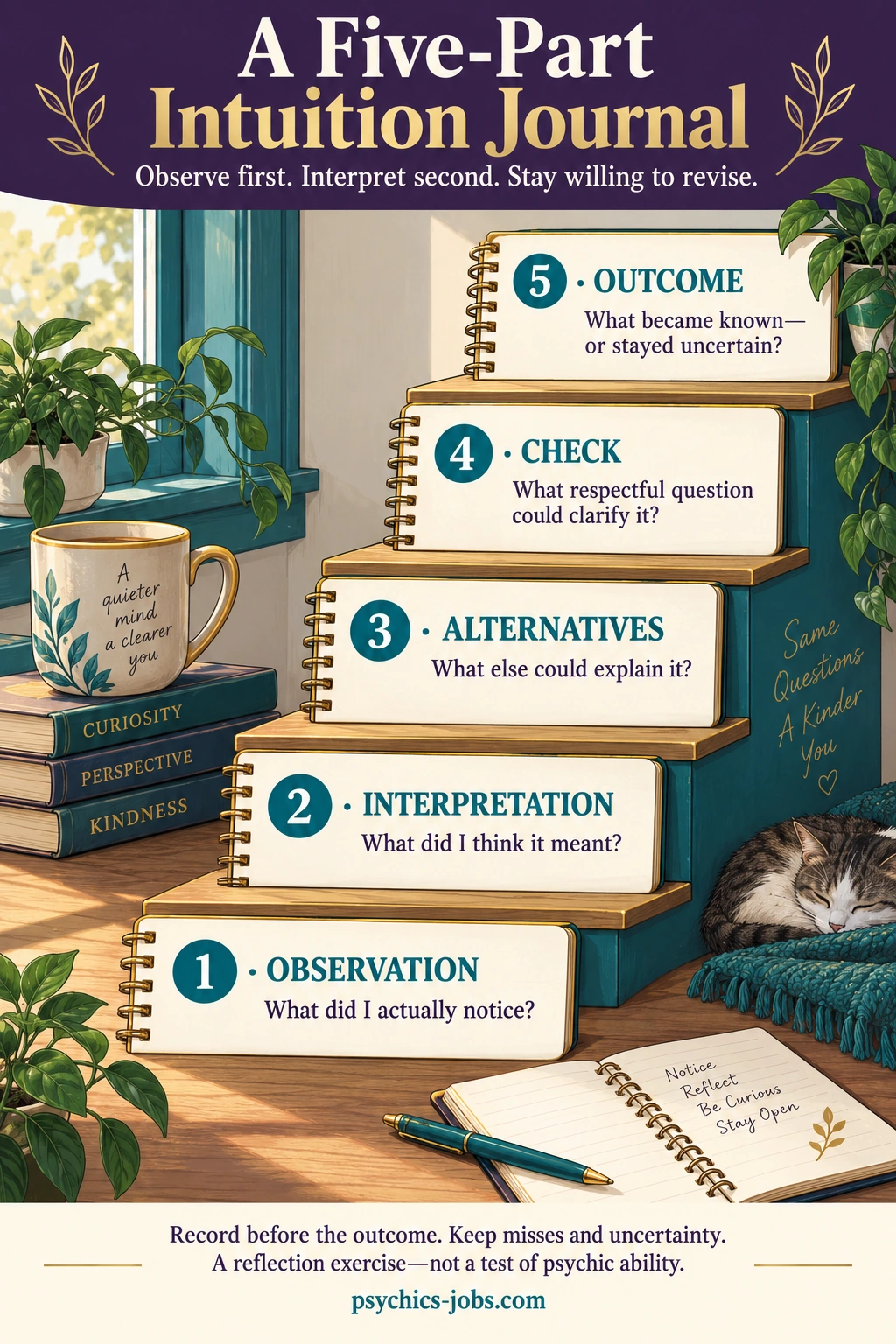
Read the infographic text
Observe first. Interpret second. Stay willing to revise.
- OBSERVATION: What did I actually notice?
- INTERPRETATION: What did I think it meant?
- ALTERNATIVES: What else could explain it?
- CHECK: What respectful question could clarify it?
- OUTCOME: What became known—or stayed uncertain?
Record before the outcome. Keep misses and uncertainty.
A reflection exercise—not a test of psychic ability.
An example from an ordinary workday
Imagine a freelancer receives a brief reply from a regular client and immediately thinks the client is unhappy. The observation is a short message; dissatisfaction is one interpretation. The client could also be busy or answering from a phone.
The freelancer asks whether any changes are needed instead of making an accusation. The client explains that the work is fine and they were between appointments. The freelancer records that their first interpretation was not supported.
This illustrative example shows useful revision, not a failure of spiritual worth. Asking a clear question achieved more than treating the initial feeling as proof.
The list of tools like Oracle cards and Tarot cards as aids in strengthening intuition is interesting. It suggests that these tools serve more as a medium for developing latent intuitive skills rather than having any inherent magical properties.
Meditation as a method to strengthen intuition is a fascinating idea. The benefits of meditation on the mind are well-documented, and extending that to intuitive abilities seems logical.
The analogy of intuition being like a muscle is quite apt. It makes sense that regular practice and mindfulness would enhance one’s innate abilities, just like physical exercise strengthens the body.
The emphasis on physical sensations—such as chills or butterflies in the stomach—as indicators of intuition is noteworthy. It’s a reminder that intuition is often experienced in very tangible, bodily ways.
It’s intriguing to see the different ‘clair’ abilities listed out. Many people often confuse intuition with clairvoyance or other psychic abilities, so the distinction provided here is quite helpful.