

Angel cards • Responsible reading practice
A thoughtful reading starts with honest limits
An angel card reading can be a spiritual or reflective conversation about images, words and personal meaning. No preparation routine can guarantee that the cards reveal the future, transmit an angel’s message or provide accurate information about another person.
Rather than promising a “true and accurate” result, aim for a clear, respectful session in which the participant understands what is being offered and remains free to disagree.
Agree on the purpose before drawing a card
Ask what the person would like to reflect on and what they do not want to discuss. Keep the question centered on their own perspective and choices, rather than claiming access to someone else’s thoughts.
For example, “What would help me prepare for a conversation at work?” leaves room for a practical response. “Will my manager fire me next month?” asks for a factual prediction the cards cannot verify.
A reading should not diagnose a health concern, determine a legal outcome or substitute for financial advice. When a question needs specialist information, acknowledge the limit and encourage the appropriate source of help.
1. Arrive able to give clear consent and attention
Choose a time when both people can understand the activity and participate freely. Do not conduct a reading when intoxication or pressure makes consent unclear. A party or group setting is not suitable for disclosing someone’s private concerns without their permission.
You do not need to empty your mind or hear a voice. A brief pause can help you notice your own expectations before interpreting a card. Remember that your interpretation remains your interpretation, even if it feels vivid or spiritually meaningful.
2. Make the surroundings comfortable and private
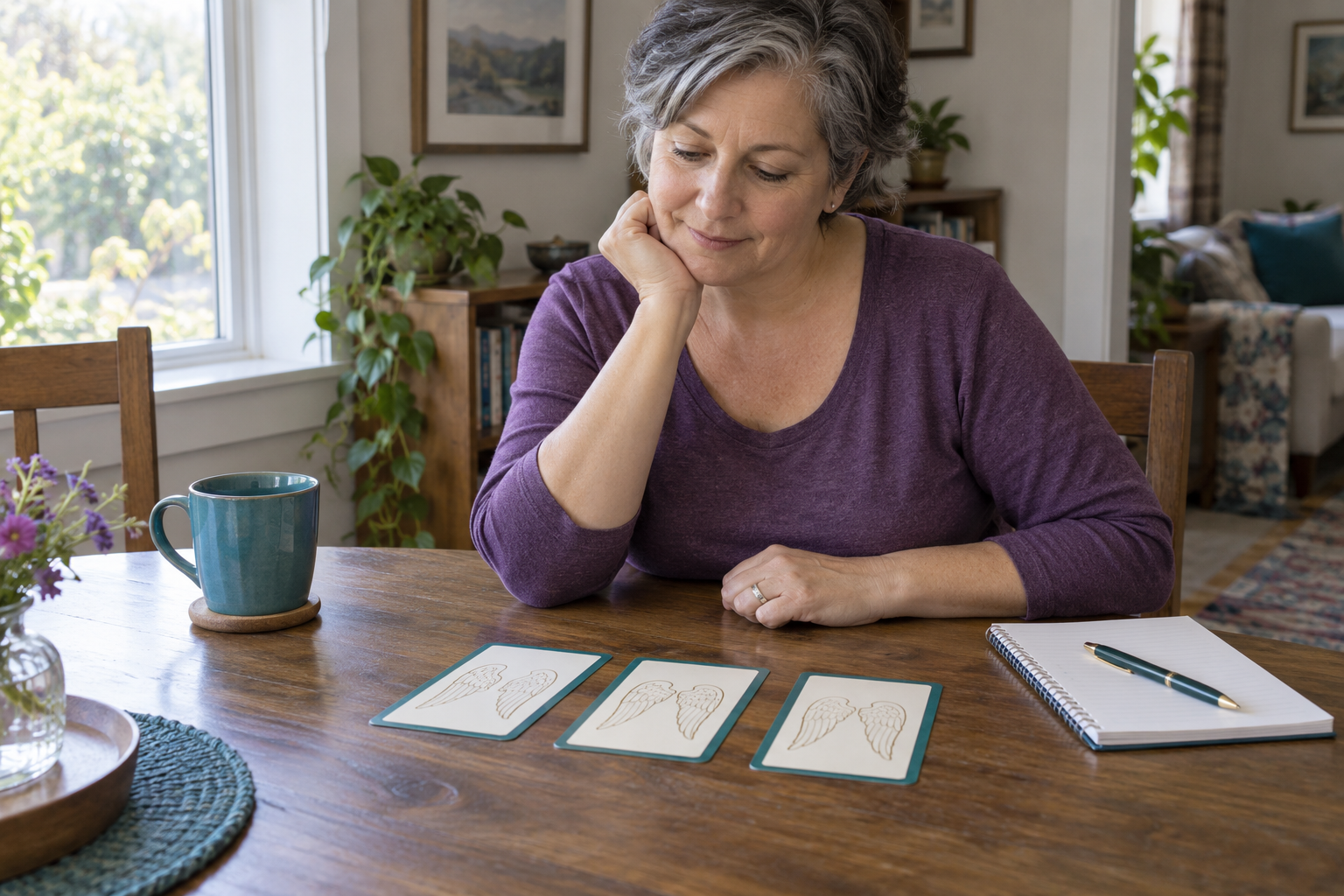
A modest home desk, living-room table or quiet yard can be enough. Agree on privacy and choose a place where conversation is easy to hear. Clear enough space for the cards without implying that clutter contains harmful energy.
Candles, scents and special objects are optional, not requirements for a valid reading. A scent-free, unlit setup avoids the need to introduce fragrance or flame. Ask before playing music, and keep it low enough that it does not interfere with the conversation.
For a remote session, check that both people can hear and that others cannot casually overhear sensitive discussion. Do not record, photograph or share the reading without explicit permission.
3. Set a time limit instead of waiting indefinitely
Give the session enough time for a thoughtful conversation, but do not promise that a message will arrive if someone waits long enough. Agree on a duration before beginning.
If the reading is paid, state the total charge or how time-based charges are calculated, explain the applicable terms and ask before any extension. Never use “the angels need more time” to justify an unexpected fee or continued session.
If nothing useful comes to mind, say so. You can stop or return to the original question without inventing a message.
4. Keep the interpretation simple and visibly your own
Start with what is actually on the card: an image, a word or a phrase. Then distinguish the association it suggests to you from what the participant has said.
- Observation: “This card includes the word ‘patience.’”
- Interpretation: “One way to reflect on that is to consider where more time might help.”
- Invitation: “Does that connect with your question, or not really?”
Do not turn a participant’s disagreement into evidence that they are blocked, negative or resisting an angel. They can say the interpretation does not fit. Avoid adding dramatic details simply to make the reading seem more impressive.
5. Prefer steadiness to compulsory positivity
You can be kind without promising that everything will work out. A participant may feel sad, doubtful or disappointed. Those feelings do not make the session unsuccessful or lower its “energy.”
Ask whether they want to continue, pause or finish. Do not claim that optimism will change a prediction or that fear will cause an unwanted event. The aim is a respectful conversation, not a performance of constant reassurance.
6. Use practical boundaries, not fear-based protection
A personal prayer or familiar object may have meaning for you, but protective spells and crystals are not required purchases. Do not tell someone that a reading exposes them to danger unless they buy protection.
Practical boundaries include consent, privacy, transparent charges, limits on the topics you address and the freedom to end the session. Avoid unsolicited claims about curses, hidden illness or imminent harm. No spiritual interpretation overrides another person’s stated wishes.
7. Know your strengths—and what they do not prove
You may be good at listening, explaining symbolism or asking reflective questions. Those are useful skills to practice. They do not establish that every impression is accurate or comes from an angel.
Use language such as “This brings to mind…” or “A possible interpretation is…” rather than presenting a personal association as external authority. If you make a specific claim and it is wrong, acknowledge that plainly instead of blaming the participant or changing the claim afterward.
End with a choice the participant owns
Ask what, if anything, was useful and whether the person wants to identify a small next step. They can choose no action at all. Do not make another reading a condition of resolving the question.
For example, someone who draws a card about communication might decide to write down a question before an upcoming meeting. The useful outcome is their chosen preparation—not proof that an angel predicted the meeting. This is an illustrative example, not a testimonial.
If you keep notes, distinguish the card drawn, the interpretation offered and the participant’s own words. Do not later present a vague reflection as a specific prediction that came true.
The article’s focus on connecting deeply with one’s inner guidance and angels is intriguing. It makes a strong case for the importance of energy and intentionality in obtaining accurate and meaningful readings.
I appreciate the clear, step-by-step guidance provided. The advice on not rushing and keeping the reading simple resonates well, as it underscores the need for authenticity and focus in spiritual practices.
The importance of protection during readings is well-articulated here. Incorporating protection spells or crystals seems like a prudent measure to ensure safety and positive experiences for both the reader and the client.
The article offers a structured methodology for conducting angel card readings. It emphasizes the importance of maintaining a clear mind and an uncluttered environment. These are sound recommendations for individuals seeking to enhance their practice.
I find the suggestions for creating a conducive environment during readings quite practical. The emphasis on avoiding intoxicating substances is particularly noteworthy, as it ensures the integrity of the reading.