


Reiki training · Practitioner boundaries · Career planning
Becoming a Reiki master usually refers to completing a particular teacher’s or organization’s advanced training. Before committing time or money, find out what the course actually teaches, what its certificate represents and what it does not authorize you to do. A spiritual training title is not evidence of medical expertise or a guarantee of paid work.
Understand Reiki and the evidence limits
Reiki practitioners typically place their hands lightly on or above a person, drawing on a belief in a healing energy. Descriptions of energy transfer, blocked energy and balancing the body belong to the practice’s explanatory framework; they should not be presented as established anatomy or a way to diagnose illness.
The National Center for Complementary and Integrative Health’s Reiki overview says that Reiki has not been clearly demonstrated to work for a health-related purpose. It describes inconsistent findings and generally limited research quality, and notes the lack of scientific evidence for the proposed energy field.
A client may value quiet time, attention or a personal spiritual ritual. That is different from proving that Reiki treats depression, relieves a disease or speeds bone and tissue healing. Do not promise those outcomes or advise someone to replace or postpone healthcare.
What does “Reiki master” mean in a course?
Ask the provider to define the title in writing. Does it mean an advanced practitioner, a teacher, or both? What assessment is involved? Who issues the certificate? A course name alone does not answer these questions.
Training structures differ. For example, the Reiki Membership Association standards published by the International Center for Reiki Training describe Reiki I and II, advanced and master training, with some courses combined and others separate. They also specify practice before advanced study. These are that organization’s training standards, not a universal law or proof of clinical effectiveness.
Beginning study
At an introductory stage, ask whether the course explains its spiritual framework, session format, respectful communication and consent. Find out how much time is spent demonstrating and practicing rather than simply watching videos.
Further practitioner study
For the next stage, ask what new material is introduced and how the teacher checks that you understand the limits of the practice. A responsible learning environment should allow questions, corrections and refusal of touch.
Advanced or teacher study
If your aim is teaching, confirm that the program actually includes teaching preparation. Ask about mentoring, observed practice, feedback and the difference between completing attendance requirements and demonstrating a skill. Do not assume a “master” certificate prepares you to supervise every client situation.
Compare training before paying
Online classes and in-person workshops may offer different kinds of interaction. Compare what you will receive rather than treating either format as automatically better. An attractive certificate or a long list of spiritual terms is not enough to judge a course.
- Content: Request a syllabus, learning objectives and an explanation of the approach taught.
- Teacher background: Ask who trained the teacher and how you can verify the qualifications they advertise.
- Practice: Confirm whether sessions are observed and whether individual feedback is included.
- Boundaries: Look for discussion of consent, touch, privacy and responding to requests outside your competence.
- Evidence: Ask how the course separates spiritual beliefs from medical claims.
- Costs: Obtain the total price, including materials, later levels, assessments and optional memberships.
- Terms: Read cancellation, refund, access and certificate requirements before enrolling.
- Follow-up: Find out what mentoring or support remains available after the course ends.
Pause if a provider discourages medical treatment, promises certain healing results, pressures you into immediate upgrades or says questioning the teaching means your energy is wrong.
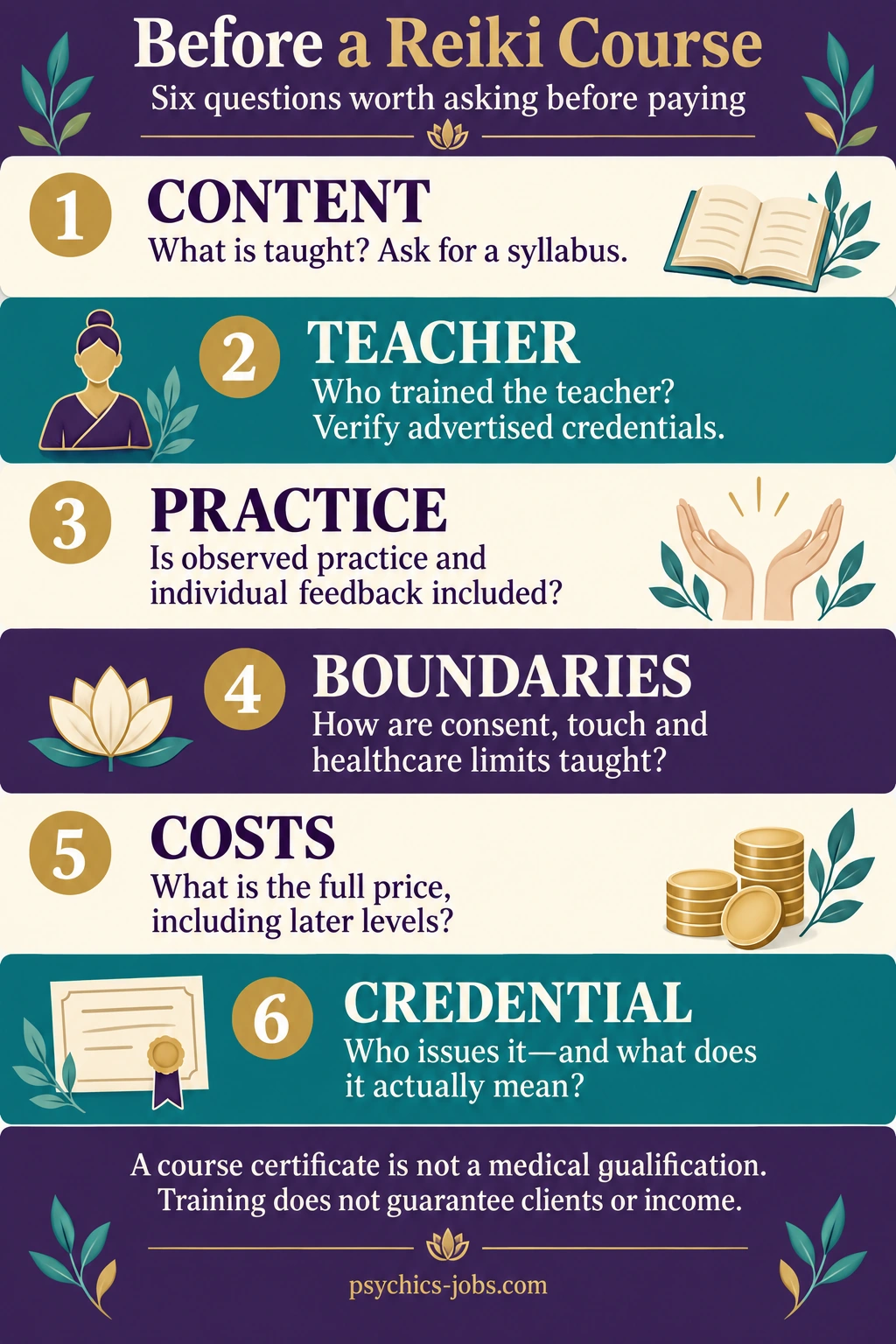
Read the infographic text
Six questions worth asking before paying
- CONTENT: What is taught? Ask for a syllabus.
- TEACHER: Who trained the teacher? Verify advertised credentials.
- PRACTICE: Is observed practice and individual feedback included?
- BOUNDARIES: How are consent, touch and healthcare limits taught?
- COSTS: What is the full price, including later levels?
- CREDENTIAL: Who issues it—and what does it actually mean?
A course certificate is not a medical qualification.
Training does not guarantee clients or income.
Certificates, memberships and licenses are different
A certificate can document completion of a named course. Membership can indicate participation in a particular association. Neither should be assumed to grant government authorization for a health profession or every service you want to offer.
Even the word “licensed” needs context. The ICRT Licensed Reiki Master Teacher program, for example, describes an affiliation and training pathway within that organization. Ask who issues any claimed license, what it covers and whether it is a governmental or private credential.
Requirements depend on where you work and what you actually do. Before offering paid services, check with the relevant local authorities and, where needed, a qualified adviser about your planned activities, advertising, business setup and insurance. This article does not determine your legal eligibility or certify compliance.
Do not advertise yourself as “licensed in alternative medicine” merely because a course awarded a Reiki certificate. Describe the exact training and issuer accurately, without implying a medical qualification.
Reiki is not interchangeable with massage therapy
Reiki may involve light touch or hands held above the body. Massage therapy involves a different set of techniques and training. The U.S. Bureau of Labor Statistics’ massage therapist guide notes that most states regulate massage therapy and require licensing or certification.
If you want to combine services, investigate each activity separately. A Reiki course does not by itself qualify you to provide massage, psychological treatment or other regulated care. Studying kinesiology or psychology can broaden an interest, but attending a class is not the same as earning authorization to practice a profession.
Be precise with clients about what is included. Avoid the vague label “Reiki massage” if it leaves people unsure whether they will receive touch, tissue manipulation, a spiritual practice or a combination.
Plan a clear, consent-based session
There is no need to promise a standard number of hand positions or a fixed result. Explain your actual format, duration and fee before the appointment. Tell the client whether they will sit or lie down and whether the session involves touch.
- Explain the limits: Do not describe the session as a diagnosis, a medical test or a guaranteed treatment.
- Ask about preferences: Obtain permission for touch rather than treating booking as consent to every action.
- Allow changes: Make it clear that the client can ask you to move, avoid an area, pause or stop.
- Keep observations modest: A feeling of warmth, relaxation or no particular sensation does not demonstrate energy transfer or a health outcome.
- Stay within your role: Refer health questions to an appropriate professional rather than interpreting symptoms as blocked energy.
Do not collect unnecessary personal details or invent assurances about how records are stored. Establish and accurately explain your actual arrangements before taking client information.
Build experience without promising a full-time income
Training, experience, local demand, competition, pricing and expenses all affect whether a service is viable. Completing advanced training does not guarantee clients, a job or sufficient income to replace other work.
Before renting a room or buying equipment, write a small business plan. List startup costs, recurring expenses, realistic available hours and the time spent on preparation, administration and follow-up. Research actual local conditions rather than relying on a teacher’s earnings story.
Do not use massage therapist pay figures as Reiki income estimates. Session fees are also not take-home pay: costs, unpaid time, cancellations and applicable taxes need separate consideration.
Illustrative planning example: A prospective practitioner calculates that they can offer only two evening appointments a week alongside existing commitments. Before purchasing an advanced course, they compare its total cost with that limited capacity and ask whether the training has personal value even if no paying practice develops. This is a planning exercise, not an earnings forecast.
Market the service honestly
Describe your format, training, availability and fees clearly. Build relationships without pressuring friends or community members to become clients. Never invent testimonials, imply clinical credentials you lack or promise a cure to fill appointments.
A client who does not notice a benefit has not failed to believe strongly enough. Respect their account and the agreed terms. If you later want to add another service, assess its training and requirements before advertising it.
The mentioned benefits of Reiki, such as reducing stress and improving relaxation techniques, align well with common goals in mental health and wellness practices. Even if it lacks scientific backing, its positive outcomes in terms of stress relief are undeniable.
The historical context provided about Dr. Mikao Usui and the etymology of the word ‘Reiki’ is quite enlightening. It’s interesting to see how such a long-established practice has persisted and evolved to meet modern therapeutic needs.
The combination of Reiki and massage therapy, referred to as Reiki Massages, seems like a holistic approach to well-being. Integrating both energy healing and physical touch could potentially offer comprehensive health benefits.
The various credentials and levels of training mentioned, such as Shoden and Okuden, lend a structured path for those interested in becoming Reiki masters. This structure might be helpful for maintaining some degree of professional standards.
While the benefits of Reiki are well-documented anecdotally, the lack of empirical evidence supporting its efficacy in medical research remains a significant barrier for its broader acceptance within the scientific community.